
Zebra TC22 vs. TC53: Is the 40% "Enterprise" Premium Worth the Investment?
Posted by The ZPS Store on Apr 10th 2026

By The ZPS Store | Mobile Computing | Device Comparison Guide
Zebra intentionally designed the TC22 and TC53 to serve different segments of the market, but they've done it so well that the overlap in features creates a genuinely difficult decision for buyers. The TC22 delivers capabilities that used to require enterprise-tier spending. The TC53 provides real performance advantages — but only if your operation actually needs them.
The risk of choosing wrong runs in both directions. Buy the TC22 when you need the TC53, and you'll deal with devices that don't survive the drop rates, the battery demands, or the processing load of your actual environment. Buy the TC53 when the TC22 would have done the job, and you've spent meaningfully more per device — multiplied across a fleet — for capabilities that sit unused.
This guide cuts through the spec sheet and frames the decision the way a purchasing manager should frame it: not "which device is better" but "which device is right for my specific deployment, and can I justify the premium?"
What They Actually Share — The Spec Sheet Surprises
Before covering the differences, it's worth being direct about what's the same — because a lot of the shared specs are features buyers often assume are only available on the TC53.
| Feature | TC22 | TC53 |
|---|---|---|
| Display size | 6.0" FHD+ | 6.0" |
| Water/dust sealing | IP68 | IP65/IP68 |
| Wi-Fi standard | Wi-Fi 6E | Wi-Fi 6E |
| Advanced range scan engine option | SE55 (by SKU) | SE55 (by SKU) |
| Android OS support through | Android 16 | Android 16 |
| Bluetooth | 5.2 | 5.2 |
| Zebra Mobility DNA suite | ✓ | ✓ |
| NFC | ✓ | ✓ |
| Removable battery | ✓ | ✓ (warm-swap) |
| Corning Gorilla Glass display protection | ✓ | ✓ |
The implication is significant: for light-to-moderate duty applications in indoor environments, the TC22 already covers most of what buyers think they need the TC53 for. The spec gaps that justify the premium are real — but they're specific, not universal.

Where the TC53 Actually Earns Its Premium
The TC53 is not more expensive because it has a better screen or a faster Wi-Fi chip — on those dimensions the devices are comparable. The premium reflects four specific areas where the TC53 is genuinely a different class of device.
1. Drop Durability: A Meaningful Spec Gap
The TC22 is rated for multiple drops from 4.3 feet (1.3 meters) to concrete per MIL-STD-810H — with an optional protective boot adding additional protection. The TC53 is rated for multiple drops from 5 feet (1.5 meters) bare, and up to 6 feet (1.8 meters) with the protective boot. The tumble specification tells a similar story: the TC22 survives 500 tumbles at 1 meter, the TC53 survives 1,000 tumbles at 1.6 feet.
In a retail environment where devices are dropped from counter height a few times per year, these specs are largely equivalent in practice. In a warehouse where devices are dropped from shoulder height onto concrete multiple times per week — sometimes with a forklift nearby — the difference between 4.3 and 5 feet becomes a fleet repair and replacement cost difference. Operations with documented high drop rates should run the numbers: if the TC53's improved drop spec reduces device replacement cycles even slightly over a 5-year deployment, the math often favors the premium.
2. Processor and Performance: Future-Proofing vs. Today's Apps
The TC53 runs Zebra's class-leading Qualcomm Snapdragon 6490 octa-core processor at 2.7GHz — a significant performance step up from the TC22's processor. The TC22 is documented at delivering twice the performance of its predecessor, which is meaningful — but the TC53 goes further, with architecture specifically designed for modern Android workloads, demanding multi-application environments, and the AI-assisted capabilities Zebra is building into its software roadmap.
For basic scanning workflows — scan barcode, update inventory record, move to next item — the processor difference is invisible. For operations running complex WMS applications, multi-threaded workflows, high-resolution camera capture with document processing, or real-time analytics dashboards on-device, the TC53's additional headroom matters. The practical question: how demanding are the applications your workers actually use? If the answer is "pretty simple," the processor premium isn't something you'll see in the field.
3. Battery Capacity and Warm-Swap: Multi-Shift Operations
The TC22 includes a 3,800mAh standard battery (5,200mAh extended option) with standard removable battery. The TC53 ships with a 4,680mAh standard battery (7,000mAh extended option) and supports warm-swap — meaning the battery can be exchanged mid-shift without powering the device down, maintaining application state throughout the swap.
The TC22's battery is adequate for most single-shift operations. The TC53's larger standard battery and warm-swap capability make a meaningful operational difference in 24/7 distribution center environments, multi-shift manufacturing floors, and any operation where downtime during battery swaps has a measurable productivity cost. PowerPrecision+ on the TC53 (versus PowerPrecision on the TC22) also provides more granular real-time battery health data — useful for fleet management in large deployments where battery health monitoring reduces unexpected device failures.
4. Workstation Connect and Ecosystem Depth
The TC53 supports Zebra's Workstation Connect solution — drop it in a compatible cradle and it becomes a full desktop workstation, connecting to a monitor, keyboard, mouse, printer, and payment terminal. This makes the TC53 a device that can replace both a handheld and a fixed workstation in applications like receiving stations, supervisor desks, and customer service counters. The TC22 also has Workstation Connect capability on select SKUs, but the TC53's ecosystem depth — including RFID sled support reading 1,300 tags per second, optional parcel dimensioning, and a broader accessory portfolio — gives it more headroom as operational needs evolve.
Where the TC22 Is Genuinely the Right Answer
The TC53's advantages are real — but they're advantages for specific operational profiles. There are many deployments where the TC22 is not just the cheaper choice but the smarter choice.
Retail Floor and Hospitality
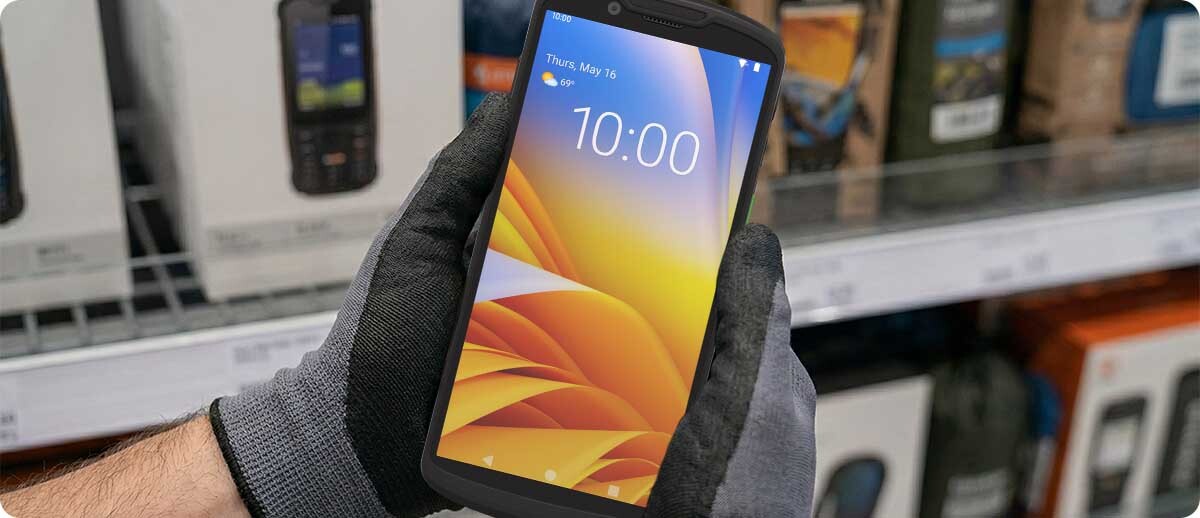
In retail environments — price checking, clienteling, assisted selling, curbside pickup, inventory lookup — the TC22's form factor is actually an advantage. It's lighter and thinner than the TC53, which matters when workers carry devices for full shifts without holsters. The drop profile of a retail floor (counter height, carpeted areas, occasional concrete in the back room) is well within the TC22's spec. The workflows are straightforward enough that the TC22's processing power is never a bottleneck. The TC22 was designed with exactly this use case in mind, and it shows.
Light Warehousing and Distribution — Single Shift
Pick-and-pack operations running a single shift with straightforward WMS workflows, moderate scan volumes, and a controlled indoor environment are well within the TC22's capability envelope. The device is IP68 sealed, has an SE55 advanced range scan engine option for workers who need to reach the top shelf, and has Wi-Fi 6E for fast, reliable network connectivity. Single-shift battery life is not a concern. The floor environment isn't going to push the drop spec to its limits. This is a TC22 deployment.
Replacing Consumer Smartphones in SMB Environments
For small and mid-sized operations upgrading from consumer smartphones to purpose-built enterprise devices for the first time, the TC22's value proposition is nearly unbeatable. It delivers everything a consumer device doesn't — ruggedness, a professional scan engine, enterprise device management, multi-year OS support, and Zebra's accessory ecosystem — at a price point that makes the upgrade ROI calculation very favorable. The TC53's additional capabilities go unnoticed in this deployment because the baseline improvement from the consumer device is so large.
Large Fleet Deployments Where Cost-Per-Device Compounds
The price difference between the TC22 and TC53 multiplied across 100, 200, or 500 devices is a material budget line. If the operational requirements are genuinely within the TC22's capability envelope, deploying TC53s at scale represents spending that could otherwise fund accessories, software licenses, extended service contracts, or additional units. Fleet size is always a relevant factor in the TC22 vs. TC53 calculation — the justification bar for the TC53 premium gets higher as the fleet gets larger.
Full Specification Comparison
| Specification | TC22 | TC53 |
|---|---|---|
| Processor | Next-gen Qualcomm (2x prior gen performance) | Qualcomm 6490 octa-core 2.7GHz |
| RAM / Storage | 6GB/64GB or 8GB/128GB | 4GB/64GB to 8GB/128GB (by SKU) |
| Display | 6.0" FHD+ (1080×2160), 450 nits | 6.0" edge-to-edge, high brightness |
| Drop Spec (bare) | 4.3 ft (1.3m) to concrete, MIL-STD-810H | 5 ft (1.5m) to tile over concrete, MIL-STD-810H |
| Drop Spec (with boot) | Improved (see accessories) | 6 ft (1.8m) to concrete |
| Tumble spec | 500 tumbles at 1.0m | 1,000 tumbles at 1.6 ft |
| Environmental sealing | IP68 | IP65 and IP68 |
| Standard battery | 3,800 mAh (PowerPrecision) | 4,680 mAh (PowerPrecision+) |
| Extended battery option | 5,200 mAh | 7,000 mAh |
| Battery swap mode | Hot swap (power-off required) | Warm swap (app state maintained) |
| Wi-Fi | Wi-Fi 6E (802.11ax) | Wi-Fi 6E (802.11ax) |
| Cellular option | TC27 only (5G/4G) | TC58 only (5G/4G) |
| Scan engine options | SE4710 standard or SE55 advanced range | SE4720 standard or SE55 advanced range |
| Rear camera | 13 MP (newer SKUs 16 MP) | 16 MP with optional OIS |
| Android OS support through | Android 16 | Android 16 |
| RFID sled support | RFD40 / RFD90 (via BT/NFC) | RFD40 / RFD90 (1,300 tags/sec via eConnex) |
| Parcel dimensioning | Not available | Optional (Time of Flight sensor SKUs) |
The Decision Framework: Five Questions That Determine the Right Device
Run through these five questions with your actual operation in mind. They cut through the spec comparison to the operational reality that determines which device pays off.
1. How often do your devices actually get dropped, and onto what surface?
If you have repair records, pull them. If devices are dropped onto concrete weekly in a high-velocity picking environment, the TC53's improved drop spec translates directly to lower repair costs and fewer device replacements. If devices are dropped on carpeted retail floors a few times per year, the TC22's spec is more than sufficient. Be honest — don't spec for the worst-case scenario if the typical scenario is much more moderate.
2. Do your workers run multiple demanding applications simultaneously, or one straightforward WMS workflow?
Scan barcode → update record → move to next item is a lightweight workflow that the TC22 handles without hesitation. Running a complex WMS alongside a real-time analytics dashboard, a communication application, and an AI-assisted receiving tool simultaneously is a different profile — one that benefits from the TC53's processing headroom. If your application is simple today but you expect significant workflow expansion over a 5-year device lifecycle, the TC53's platform gives you more room to grow without a mid-cycle upgrade.
3. Do you run multiple shifts, and do battery swaps during shifts cause measurable disruption?
The TC53's warm-swap capability is only valuable if powering down for a battery swap actually costs you something. In a single-shift operation where the device is charged overnight and returned to service fully charged each morning, both devices behave identically for battery purposes. In a 24/7 DC where workers hand off devices between shifts and battery swaps happen on the floor, the TC53's warm-swap maintains application state and eliminates the restart time and reconnection steps that cold-swap requires.
4. Does your operation involve use cases that only the TC53 supports — RFID, parcel dimensioning, Workstation Connect POS?
If your operation has a current or near-term requirement for RFID cycle counting via sled, mobile parcel dimensioning for shipping cost optimization, or replacing fixed POS workstations with a device-in-cradle solution, the TC53 is the correct platform. These use cases either don't exist on the TC22 or are supported at a lower performance level. If none of these apply today and the roadmap doesn't include them, this factor doesn't move the needle.
5. How many devices are you deploying, and how does the price delta compound?
The premium between the TC22 and TC53 at the per-device level becomes a significant budget decision at fleet scale. The right question isn't whether the TC53 is "worth it" in absolute terms — it usually is, for the right deployment. The question is whether the operational advantages of the TC53 over the TC22 justify the aggregate cost difference for your specific fleet size and use case. For a 10-device retail deployment, the answer is often yes. For a 300-device distribution center deployment running straightforward single-shift scan workflows, the TC22 may be the financially defensible choice even if the TC53 is technically superior.
Shop Both Devices at The ZPS Store
Zebra TC22 Mobile Computer
The right choice for retail, hospitality, light warehousing, and SMB deployments where value, ergonomics, and straightforward scanning workflows are the priority. Wi-Fi 6E, IP68, SE55 advanced range scan engine option, Android through 16, Mobility DNA suite. Multiple configurations available including standard and extended battery SKUs and BLE battery options.
Shop Zebra TC22 →
Zebra TC53 Mobile Computer
The right choice for high-impact warehouse environments, multi-shift operations, demanding application workloads, and deployments with RFID, parcel dimensioning, or POS requirements. Qualcomm 6490 2.7GHz processor, 5ft/6ft (with boot) drop spec, warm-swap 4,680mAh battery, PowerPrecision+, Android through 16. Multiple configurations available by scan engine, memory, and accessory compatibility.
Shop Zebra TC53 →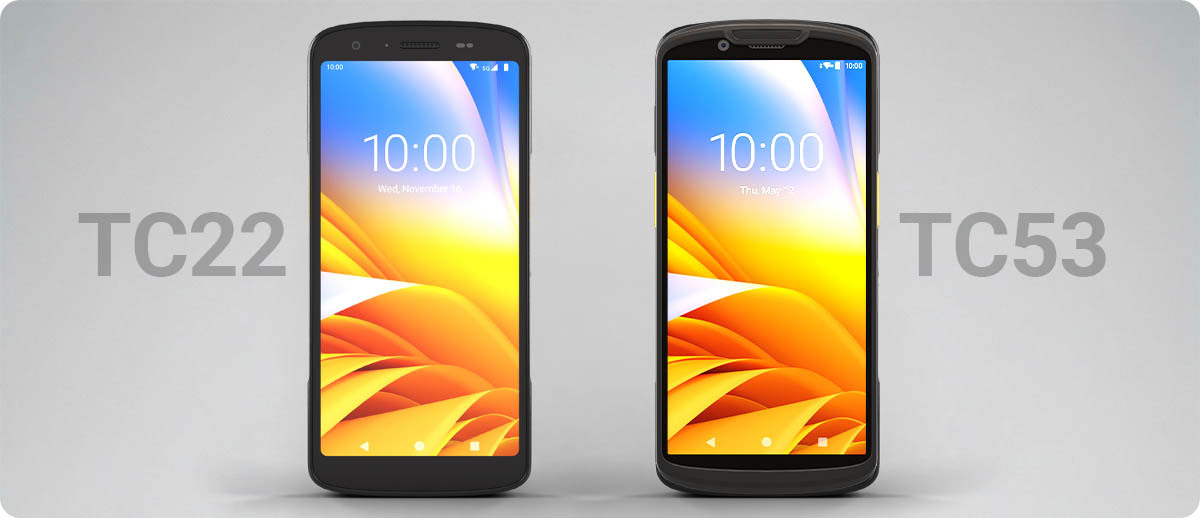
Frequently Asked Questions: TC22 vs. TC53
Can the TC22 run the same apps as the TC53?
Yes — both run Android with Google Mobile Services and are fully compatible with standard enterprise Android applications including most WMS, ERP, and productivity tools. The difference is processing performance under demanding multi-application loads, not application compatibility. If your app runs on one, it will run on the other; the question is how smoothly it runs when the device is pushed hard.
Does the TC22 work with Zebra accessories — cradles, trigger handles, boots?
Yes. The TC22 has a full Zebra accessories ecosystem including single-slot and multi-slot charging cradles, protective boots, trigger handles, wrist mounts, and a Workstation Connect cradle. The TC22 and TC53 don't share accessories — they use separate cradle families — which is an important planning consideration if you're running a mixed fleet or adding devices to an existing cradle infrastructure.
Is the TC53 being replaced by the TC53e? Should I be buying TC53e instead?
Zebra has introduced the TC53e as a platform-forward evolution with a newer processor and enhanced security features. The TC53 remains available and is fully supported. For new deployments today, the TC53e offers a longer viable lifecycle on a newer platform — but the TC53 is still a current, capable device for operations where the TC53e's additional capabilities aren't required. The ZPS Store carries the current TC53 lineup — contact us if you have questions about TC53e availability and how it fits into your decision.
We need 5G cellular capability. Does that change the decision?
Both device families offer a cellular option: the TC22's cellular sibling is the TC27, and the TC53's cellular sibling is the TC58. If cellular connectivity is required — field service, outdoor operations, delivery, or any application outside Wi-Fi coverage — the TC27 and TC58 are the relevant comparison rather than TC22 vs. TC53. Both add cellular capability at an additional price premium over their Wi-Fi-only counterparts.
We already have a fleet of TC52 devices. Should we upgrade to TC53 or is the TC22 sufficient for a refresh?
The TC53 is the direct generational successor to the TC52, sharing the same TC5x product line and maintaining backward accessory compatibility with TC52 cradles and peripherals. If you're refreshing a TC52 fleet, the TC53 preserves your existing infrastructure investment — your TC52 cradles and most accessories will work with the TC53 without replacement. The TC22 would require new accessory infrastructure and is positioned as a different market tier than the TC52 series. For most TC52 fleet refreshes, the TC53 is the natural path.
Still on the fence between the TC22 and TC53 — or trying to build a business case for one over the other? We can help you work through it. Whether you're configuring a 10-device retail rollout or evaluating options for a larger fleet refresh, our team knows the Zebra lineup inside and out and can help you match the right device to your actual environment and budget. Fill out the form below and let's figure out which one makes sense for your operation.